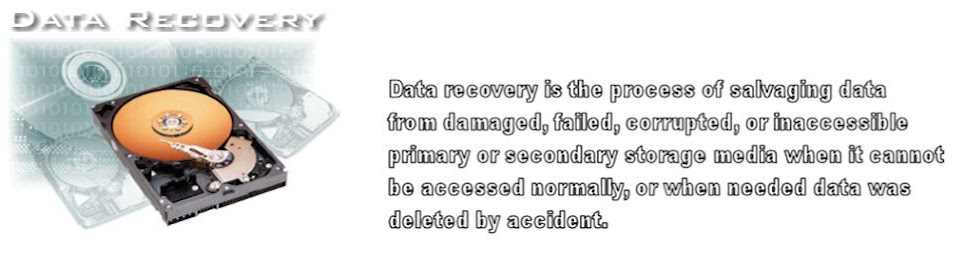
-Does your computer fail to bootup?
-Does your computer freeze and reboot?
-Cannot access your data due to the lost password?
-Does your computer contain critical data?
-Don't have a recent backup?
-Reformatted your harddrive?
-Accidentally deleted files?

Our blog will provide the relevant information on free tools, techniques, and approaches to recover your computer and get your valuable data back.

Showing posts with label damaged hard drive recovery. Show all posts

DriveImage XML – freeware backup and recovery software

DriveImage XML – a freeware but still feature rich disk backup and recovery software, having some advanced features, usually not available in free utilities, such as ability to schedule the disc backup tasks. Among other attractive features are:
  • The disk images can be created while the drive is in use.
  • Similarly, the images can be restored without requiring rebooting the system.
  • The program will backup, image and restore drives formatted with FAT 12, 16, 32 and NTFS.
  • You can also initiate the imaging process from the command line.
DriveImage XML is an easy to use and reliable program for imaging and backing up partitions and logical drives.

Image creation uses Microsoft's Volume Shadow Services (VSS), allowing you to create safe "hot images" even from drives currently in use. Images are stored in XML files, allowing you to process them with 3rd party tools. Never again be stuck with a useless backup! Restore images to drives without having to reboot. DriveImage XML is now faster than ever, offering two different compression levels.

DriveImage XML runs under Windows XP, Windows Server 2003, Vista and Windows 7 only. The program will backup, image and restore drives formatted with FAT 12, 16, 32 and NTFS.

Private home users are allowed to use the Private Edition of DriveImage XML without charge. You are allowed to install DriveImage XML on your home PC. You must not use DriveImage XML commercially.

Main Features

  • Backup logical drives and partitions to image files.
  • Browse images, view and extract files.
  • Restore images to the same or a different drive.              
  • Copy directly from drive to drive.
  • Schedule automatic backups.
  • Run DriveImage from WinPE boot CD-ROM.

For the fans of portability, there are instructions from http://www.portablefreeware.com/?id=496 on how to make the utility portable (and that is quite easy):
  1. Download the installer and install to the default folder.
  2. Copy all files (except Uninstall.exe, INSTALL.LOG and install.sss) to a folder of your choice.
  3. Uninstall the program.
  4. Launch dixml.exe.


ODIN – Open Source Windows Disk Clone Utility

ODIN (Open Disk Imager in a Nutshell) is a free, user-friendly, utility for easy backup of hard drive volumes or complete hard drives under Windows Operating System.

Main Features

  • Backup/restore of volume or complete hard disk.
  • Backup only used clusters to save operational time, or all blocks.
  • Compression on the fly option is available to save valuable storage space.
  • Verify backup image files for damages.
  • Support of all Windows file systems (both 32-Bit and 64-Bit).
  • Split image files to chunks (e.g. for burning to CD/DVD).
  • Utility is portable, it does not require installation, just start odin.exe.
  • Can be run from USB stick.
  • Supports Windows PE (BootDisks, BartPe, etc.).
  • Use multiple CPUs.
  • Offers snapshots of volumes.
New Version in latest version 0.3 (latest release 0.32 Beta)

New Features of version 0.3 are:
  • Command Line interface
  • 64-Bit version available
ODIN now can be run in two modes, either with a GUI or from a console as command line application. All options and functions are available from command line. See -usage for details. The command line application is started as ODINC.exe. The GUI application is started as ODIN.exe without any command line parameter. The console mode is for example useful for automated tasks running from scripts.

Important notes:
  • To use from the command line under Vista or higher (with User Account Control enabled) start the console as Administrator!
  • The 64-Bit version now allows making snapshots on 64-Bit operating systems. Due to Windows limitations this was not possible before with a 32-Bit application running on a 64-Bit Windows.
License

This program is licensed under the GNU public license.

Developer’s website: http://odin-win.sourceforge.net/


How to revive your dead Hard Drive?

If you have intermittently failing Hard Drive, your first step would be to backup all the important data you have there. Mechanical failures are often deadly, and the drive cannot be recovered without professional tools and facilities (clean room, for starter). But if it looks like dead, it does not mean that you cannot revive it, at least temporary. All you need just half an hour of temporary recovery to save all your valuable data. The article “200 Ways to Revive a Hard Drive” has been written long ago (in 2000) by TechRepublic specialists. Unfortunately, the eBook is not available from their web site any more. Still, it can help you in fatal failures, even thou some methods might look funny and unprofessional.

All solutions are divided into four categories:

  • Freeze it
  • Drop it
  • Hit it
  • The rest of the solutions
You can find different approaches and ways, and sometimes you can try several methods to get positive results. I have personally recovered several customer’s dead hard drives, using these “funny” techniques, and the last case was just two weeks ago.

Just remembers that by using these methods you might not reach any success at all, or even make things worse. So, apply them only when you have nothing to loose.

Data Recovery Techniques © 2008. Template by Dicas Blogger.

TOPO